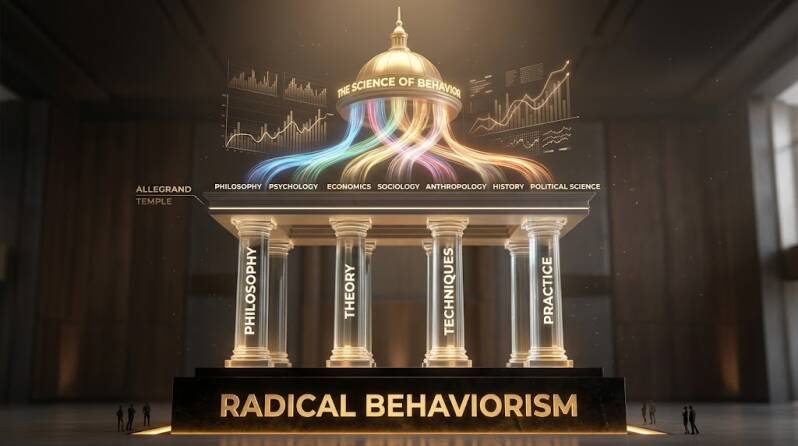
The grand unification: How the science of Behavior Integrates the Social Sciences
For over a century, the social sciences have operated like a fragmented archipelago. Economists build models based on rational choice, sociologists analyze invisible social structures, psychologists debate internal mental constructs, and historians chronicle the rise and fall of civilizations. Each discipline speaks its own language, uses its own methods, and defends its own academic territory.
Yet, beneath all these disciplines lies a single, undeniable common denominator: an organism interacting with its environment. Whether a consumer is buying a stock, a citizen is obeying a law, a tribe is performing a ritual, or a board of directors is executing a strategy—it is all behavior.
As B.F. Skinner already envisioned in Science and Human Behavior, a true natural science of behavior does not replace the social sciences; it provides the foundational bedrock that unifies them. By moving away from hypothetical inner causes (like willpower, culture, or market sentiment) and focusing on observable environmental contingencies, we can finally integrate the social sciences into one coherent, empirical framework.
To understand how this integration works, we must first look at the four pillars of our behavioral architecture.
Part I: The Four Pillars of the Behavioral Framework
To unify the study of human action, behavior science operates across four distinct yet seamlessly connected levels:
1. Premises (Philosophy): Radical Behaviorism
Every science rests on philosophical assumptions. Radical Behaviorism is the philosophy of the science of behavior. Unlike methodological behaviorism, it does not ignore private events (thoughts, feelings, and introspection); rather, it strips them of their causal status. Thoughts and emotions are not the causes of behavior—they are more behavior to be explained by the environment. It replaces dualism and mentalism with a strict, pragmatic naturalism: behavior is a lawful, biological phenomenon determined by selection by consequences.
2. Theory (Basic Science): The Experimental Analysis of Behavior (EAB)
This is the fundamental discovery engine, built on decades of rigorous laboratory research (such as that published in JEAB). EAB uncovers the universal, mathematical laws of how organisms adapt to their environment. Principles such as the Matching Law, behavioral momentum, temporal discounting, and contingency-shaped versus rule-governed behavior form the theoretical grammar of all human and animal action.
3. Techniques (Methodology): Applied Behavior Analysis (ABA)
Theory without measurement is mere speculation. ABA translates basic behavioral laws into rigorous, data-driven methodologies for the real world. It provides the technical toolkit: pinpointing observable behaviors, functional (ABC) assessments, single-subject experimental designs, baseline measurement, visual feedback graphs, and the systematic design of reinforcement schedules.
4. Practice (Application): Organizational Behavior Management (OBM) & Societal Design
This is where the rubber meets the road. In the practice of OBM, behavioral systems analysis, and public policy, we apply these techniques to complex human systems. Whether improving safety on construction sites, optimizing leadership in boardrooms, or executing disciplined capital allocation in financial markets, practice is the deliberate engineering of environments to maximize human potential.
Part II: Reframing the Social Sciences under the Behavioral Umbrella
When we apply these four pillars—premises, theory, techniques, and practice—across the academic landscape, the traditional walls between the social sciences dissolve. Here is how the major disciplines integrate under the Science of Behavior:
1. Philosophy
The Traditional View: Often bogged down in metaphysical debates about free will, consciousness, moral absolutism, and dualistic theories of mind.
The Behavioral Integration: Under Radical Behaviorism, philosophy becomes pragmatic and empirical. Epistemology (how we know what we know) is reframed as the study of verbal behavior—how a verbal community shapes our concepts and scientific repertoire. Ethics and morality are no longer abstract commandments; they are analyzed as the competing contingencies between what reinforces the individual in the short term versus what ensures the survival of the group in the long term.
2. Psychology
The Traditional View: Dominated by cognitive metaphors (the brain as a computer) and mentalistic constructs (traits, attitudes, intrinsic motivation, and subconscious drives) that often blame or credit the individual for their actions.
The Behavioral Integration: Behavior analysis returns psychology to the natural sciences. Instead of trying to fix a broken mindset or change an attitude, it looks at the individuals learning history and current ABC contingencies. Clinical, social, and organizational psychology merge into a single question: What environmental conditions are currently maintaining this repertoire, and how can we redesign them?
3. Economics & Finance
The Traditional View: Classical economics assumes a mythical Homo Economicus making rational calculations, while behavioral economics merely catalogs cognitive biases as flaws in human wiring.
The Behavioral Integration: Economics is literally the allocation of behavior under scarcity. The Matching Law (Herrnstein), Token Economies (Hackenberg), and Temporal Discounting (Rachlin & Green) provide the exact mathematical foundation for micro- and macro-economic behavior. Market bubbles and crashes are not mysterious waves of madness; they are predictable outcomes of social reinforcement (herd behavior) and short-term contingencies overriding long-term fundamental value.
4. Sociology
The Traditional View: Focuses on macro-phenomena—institutions, class structures, bureaucracy, and social norms—often treating society as an autonomous entity that exists above the individual.
The Behavioral Integration: Behavior science bridges the micro-macro gap through the concept of metacontingencies and rule-governed behavior (Galizio). An institution or bureaucracy is nothing more than an interlocking network of individual behavioral contingencies (interlocking behavioral contingencies or IBCs) that produce an aggregate product. Social norms are simply the socially mediated consequences enforced by a group.
5. Anthropology
The Traditional View: Studies cultures, rituals, traditions, and belief systems as symbolic webs of meaning passed down through generations.
The Behavioral Integration: Skinner introduced the third level of selection: cultural selection. Just as natural selection shapes species and operant conditioning shapes the individual, cultural practices are selected by their consequences for the survival of the group. Even seemingly irrational rituals and taboos can be explained through accidental reinforcement (superstitious behavior) and delayed contingencies (Lattal & Gleeson) that become codified into verbal rules.
6. History
The Traditional View: Often written as a narrative of Great Men, ideological clashes, or inevitable cycles of fate.
The Behavioral Integration: History is the ultimate longitudinal database of selection by consequences. As we explored previously, the rise and collapse of empires, economic systems, and organizations can be analyzed by looking at the shifting reinforcement ratios of a society. When a civilization’s complexity increases to the point where the molar correlation between productive effort and reinforcement breaks down (Baum), behavioral momentum stalls, and the system collapses.
7. Political Science & Public Administration
The Traditional View: Focuses on power, legislation, governance, and ideological debates, relying heavily on coercion, laws, and punitive measures to control citizens.
The Behavioral Integration: Legislation is the design of national contingencies. Politicians almost universally confuse antecedents (laws, press releases, moral appeals) with consequences. A behavioral approach to governance moves away from ineffective punitive control (which breeds counter-control and extinction-induced aggression) toward designing small, immediate, positive reinforcements and structural commitment devices that naturally align citizen behavior with societal goals.
Conclusion: From Fragmented Observation to Unified Action
Why does this integration matter? Because as long as the social sciences remain divided, our solutions to organizational and societal crises will remain superficial. You cannot solve a macroeconomic problem without understanding individual temporal discounting; you cannot fix a sociological bureaucracy without understanding rule-governed behavior; and you cannot lead an organization without mastering the techniques of positive reinforcement.
Radical behaviorism and the science of behavior offer us a unified lens. They strip away the comforting illusions of mentalism and replace them with something far more powerful: the ability to measure, predict, and constructively shape human destiny.
In a forthcoming series of articles, I will unpack each of these disciplines one by one—showing how the synthesis of behavioral science and the social sciences provides actionable breakthroughs for leaders, policymakers, and investors.
Which of these disciplines do you think is most in need of a behavioral awakening?
#BehavioralScience #OBM #RadicalBehaviorism #SocialSciences #Leadership #Economics #Sociology #Psychology #ABA #Strategy
We pride ourselves on our adaptability and commitment to excellence in every aspect of our service. Explore what we have to offer and how we can contribute to your success.