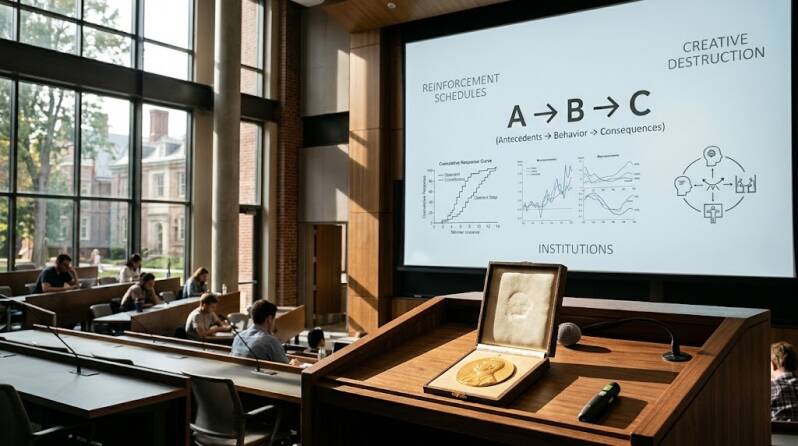
The Contingencies of Prosperity: Evaluating the Latest Nobel Laureates in Economics
When the Royal Swedish Academy of Sciences announces the Sveriges Riksbank Prize in Economic Sciences, the academic world applauds complex mathematical models, macroeconomic equilibria, and historical regressions. Yet, if we strip away the econometric jargon and look at what economics actually studies, we are left with a single, undeniable subject: human behavior under shifting contingencies of reinforcement.
Over the past three years, the Nobel Committee has honored a fascinating triad of economic thought:
-
2026: Robert E. Hall & Michael Woodford — For the microeconomic foundations of macroeconomic stabilization (consumption, sticky prices, and monetary policy).
-
2025: Joel Mokyr, Philippe Aghion & Peter Howitt — For explaining innovation-driven economic growth and Schumpeterian "creative destruction."
-
2024: Daron Acemoglu, Simon Johnson & James A. Robinson — For studies of how inclusive versus extractive institutions shape the wealth of nations.
Mainstream economists often fall into the trap of mentalism: they explain economic shifts by pointing to invisible internal constructs such as "consumer confidence," "rational expectations," "entrepreneurial spirit," or "cultural trust."
What happens when we subject these Nobel-winning theories to the rigorous measuring stick of B.F. Skinner’s radical behaviorism and Applied Behavior Analysis (ABA)? We discover that these laureates are—often without realizing it—describing the exact mechanics of the Three-Term Contingency (Antecedent – Behavior – Consequence) on a societal scale.
1. The 2026 Prize (Hall & Woodford): Macroeconomic Stabilization or Verbal Stimulus Control?
This year’s laureates, Robert E. Hall and Michael Woodford, were awarded the prize for providing the microeconomic foundations of macroeconomic stabilization—explaining how individual decisions by households and firms interact with monetary shocks.
-
Hall’s Random Walk of Consumption (1978): Hall famously demonstrated that under the permanent income hypothesis, consumption follows a "random walk." Mainstream economics frames this mentalistically: consumers cognitively calculate and "expect" their lifetime income and smooth their spending accordingly.
-
The Behavioral Reality: An organism does not react to a mathematical abstraction of the future; it reacts to its reinforcement history. What economists call "consumption smoothing" is simply the stability of an established operant baseline. Once a household’s behavioral repertoire (spending habits) is maintained by a reliable schedule of reinforcement, temporary fluctuations fail to disrupt the pattern—unless a salient discriminative stimulus ($S^D$) signals a permanent shift in reinforcement availability.
-
Woodford’s New Keynesian Framework & "Forward Guidance": Woodford revolutionized central banking by showing how monetary policy works largely through managing "expectations" amidst sticky prices. Central bankers talk about anchoring inflation expectations.
-
The Behavioral Translation: Strip away the cognitive illusion of "expectations," and central bank "forward guidance" reveals itself as pure rule-governed behavior (verbal discriminative stimuli, $S^D$). When a central bank announces an interest rate trajectory, it is not altering a mystical mental state inside the heads of CEOs; it is altering the verbal antecedents that signal future response costs (the price of borrowing capital). Furthermore, Woodford’s later work on bounded rationality and imprecise perception closely mirrors stimulus discrimination: organisms do not have perfect information; they respond to the most salient environmental cues within their perceptual threshold.
2. The 2025 Prize (Mokyr, Aghion & Howitt): Creative Destruction as Operant Variation and Selection
In 2025, Joel Mokyr, Philippe Aghion, and Peter Howitt received the Nobel for explaining how technological innovation drives sustained growth through creative destruction.
In corporate and political circles, innovation is almost always discussed in mentalistic terms: "genius," "visionary leadership," or "creativity." Skinner dismantled this illusion decades ago by drawing a direct parallel between natural selection in evolutionary biology and operant conditioning in human behavior.
-
Innovation is Behavioral Variation: In the Aghion-Howitt model, firms invest in R&D to capture monopoly rents, rendering old technologies obsolete. Behaviorally, R&D is structured operant variability. When an existing schedule of reinforcement begins to thin, or when the environment offers a massive primary/generalized reinforcer (market dominance and capital accumulation, $R^+$), organisms emit novel behavioral variations.
-
The Market as the Selecting Environment: Just as nature selects random genetic mutations that enhance survival, the free market acts as the selecting environment for behavioral variations. A new technology or business model is simply an operant response. If it lowers response costs for consumers or delivers superior reinforcement, the market reinforces the innovator ($R^+$).
-
Creative Destruction is Operant Extinction: What Schumpeter and Aghion call the "destruction" of incumbent firms is literally behavioral extinction. When a superior innovation enters the market, the reinforcement schedule that previously maintained the incumbent’s legacy behavior is severed. Incumbents who fail to adapt—often goes hand in hand with an extinction burst of lobbying for state protection or subsidies—eventually see their organizational behavior extinguish. Mokyr’s emphasis on a "culture of growth" during the Industrial Revolution was, at its core, the removal of institutional punishers ($P^+$) against scientific experimentation, allowing operant variation to flourish freely.
3. The 2024 Prize (Acemoglu, Johnson & Robinson): Institutions as Macro-Schedules of Reinforcement
The 2024 laureates (Acemoglu, Johnson, and Robinson, authors of Why Nations Fail) proved that nations do not prosper because of geography, climate, or ethnocentric "work ethics," but because of their institutions. They distinguish between inclusive institutions (which protect property rights and create level playing fields) and extractive institutions (where an elite expropriates the wealth of the many).
From a radical behaviorist perspective, an institution is nothing more and nothing less than a codified matrix of reinforcement contingencies.
-
Extractive Institutions = Ratio Strain and Learned Helplessness: When a farmer, entrepreneur, or worker invests effort (Behavior) and the state or ruling oligarchy confiscates the output via arbitrary taxation, corruption, or expropriation, the connection between response and consequence is severed. In the behavioral laboratory, if you increase the work requirement infinitely without delivering reinforcement (ratio strain) or apply inescapable aversive stimuli, the organism stops pressing the lever. What economists call "economic stagnation in extractive regimes" is simply mass operant extinction and avoidance behavior (capital flight, brain drain, and black markets).
-
Inclusive Institutions = Reliable Schedules of Reinforcement: Why do inclusive institutions generate unprecedented wealth? Because secure property rights, rule of law, and free price signals establish a rock-solid, predictable contingency between productive behavior and positive reinforcement ($R^+$). When an individual knows with high probability that the value they create will not be confiscated, the reinforcement schedule remains intact, driving high, sustained rates of operant responding (investment, labor, and innovation).
The Behavioral Synthesis: Nobel Economics vs. Radical Behaviorism
To make this translation concrete for economists, strategists, and organizational leaders, the last three Nobel Prizes map directly onto behavioral science:
1. 2026 Laureates: Hall & Woodford ▪ Economic Concept: Consumption Smoothing & Forward Guidance ▪ Mentalistic Trap: "Consumer confidence" & "Inflation expectations" ▪ Behavioral Reality (ABA): Baseline stability under habitual schedules & Rule-Governed Behavior via verbal discriminative stimuli ($S^D$).
2. 2025 Laureates: Mokyr, Aghion & Howitt ▪ Economic Concept: Innovation & Creative Destruction ▪ Mentalistic Trap: "Entrepreneurial spirit" & "Visionary genius" ▪ Behavioral Reality (ABA): Operant Variation and Selection by consequences; market extinction of obsolete behavioral repertoires.
3. 2024 Laureates: Acemoglu, Johnson & Robinson ▪ Economic Concept: Inclusive vs. Extractive Institutions ▪ Mentalistic Trap: "National culture" & "Civic trust" ▪ Behavioral Reality (ABA): Macro-Contingencies of Reinforcement; predictable $R^+$ (property rights) vs. operant extinction and punisher-driven avoidance (expropriation).
Why Economists Need B.F. Skinner (And Vice Versa)
When we place the 2024, 2025, and 2026 Nobel Prizes side by side, a powerful conclusion emerges. Economics is at its strongest when it analyzes how external structures—property rights (2024), open competition (2025), and stable monetary rules (2026)—shape human action. It is at its weakest when it retreats into the human skull to invent cognitive fictions about how an imaginary Homo Economicus calculates utility.
Whether you are governing a central bank, deregulating an economy to spark innovation, or leading an organization through a strategic transition: you cannot manage "expectations," "mindsets," or "cultures" directly. You can only design the environment.
As Milton Friedman’s price theory and B.F. Skinner’s experimental analysis of behavior both prove from different angles: if you want to understand why nations, markets, or organizations succeed or fail, stop asking what people think or expect. Look at the contingencies of reinforcement. Change the consequences, and the behavior will follow.
#NobelPrize #Economics #BehavioralAnalysis #RadicalBehaviorism #BFSkinner #MonetaryPolicy #CreativeDestruction #InstitutionalEconomics #OBM #BehavioralStrategy #FreeMarkets
This is where our journey begins. Get to know our business and what we do, and how we're committed to quality and great service. Join us as we grow and succeed together. We're glad you're here to be a part of our story.