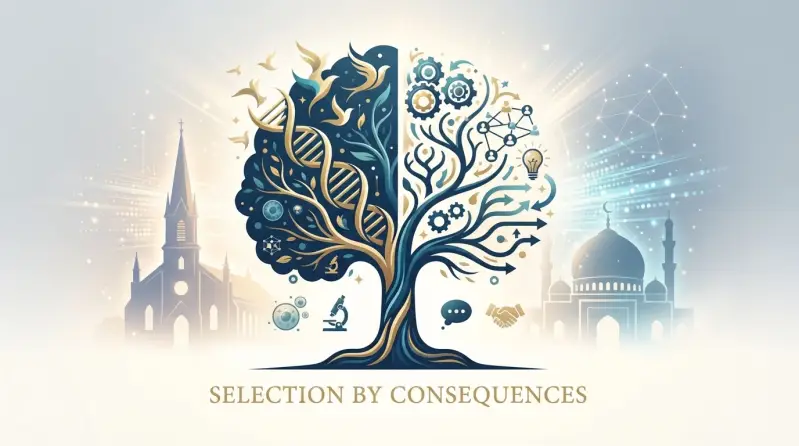
Beyond Delusion: A Behavior-Analytic View on Religion and Belief
Many people assume that evolutionary biologists and behaviorists occupy opposite ends of the intellectual spectrum. Nothing could be further from the truth.
Richard Dawkins actually contributed an essay titled "Replicators, consequences, and displacement activities" to the 1988 volume The Selection of Behavior: The Operant Behaviorism of B.F. Skinner: Comments and Consequences. The reason for his interest was clear: both Darwin and Skinner discovered a mechanism for selection without a designer:
-
For Darwin, genes are selected by survival and reproduction.
-
For Skinner, behavior is selected by its consequences (selection by consequences).
Dawkins frequently points to Skinner’s famous 1948 experiment with superstitious pigeons. These pigeons, receiving food randomly regardless of their actions, developed fixed rituals — such as turning counter-clockwise or nodding their heads — because they happened to be performing that action just before the food appeared. Dawkins sees this as the exact mechanism through which human superstition and religious rituals originate: an accidental correlation between an action and a positive outcome is powerfully reinforced.
But how would B.F. Skinner himself review Dawkins’ bestseller The God Delusion?
I believe he would offer a response combining deep appreciation with sharp, behavior-analytic criticism:
-
Agreement on Naturalism: Skinner — himself a dedicated humanist and atheist — would wholeheartedly agree with Dawkins that you do not need supernatural explanations to understand human behavior or the natural world. For Skinner, religious institutions are powerful social controlling agencies that manage behavior through promises of reinforcement (Heaven, salvation) and threats of punishment (Hell, damnation).
-
Criticism of Mentalism (the term "delusion"): Skinner would immediately flag the word delusion as a mentalistic trap. From the perspective of radical behaviorism, a "belief," a "faith," or a "delusion" is not an internal, causal state of mind. Instead, it is a label we apply to complex verbal and ritual behavior that has been shaped and maintained by environmental contingencies.
-
Why Debate Alone Often Fails: Dawkins primarily attempts to combat religion using logical arguments and scientific refutation. A behavior analyst immediately sees why this often has limited effect. Verbal and ritual behavior does not simply disappear because of a counter-argument, as long as the reinforcement contingencies in the social environment remain intact. People do not attend a church, mosque, or temple merely for an abstract statement about the origin of the universe; they go for community, rhythm, comfort, social approval, and shared rituals — often on a powerful variable reinforcement schedule (e.g., prayer seems to work "sometimes," and that is precisely what keeps the behavior strongest).
Explaining Secularity: What Happens When Alternative Behavior Pays Off More?
From a behavioral perspective, secularization can be explained remarkably clearly — not necessarily because everyone suddenly reads philosophical books, but through what the field calls the matching law: when individuals can choose between different behavioral options, their behavior inevitably shifts toward the option that yields the strongest, most immediate reinforcement in practice. In a modern society, countless powerful alternative reinforcers have become available (work, education, sports, travel, social networks, entertainment, and financial security outside the faith community), while the social costs of abstaining have decreased.
This shift is visible in the data, both within Christianity and within Islam:
-
In the Netherlands (CBS Statistics): The percentage of the Dutch population that does not adhere to any religious denomination or ideological group has risen to nearly 58% (compared to about 50% around 2015 and roughly 42% in 2010). The percentage of people who still regularly (at least monthly) attend a religious service dropped in the same period from over 20% to approximately 12% to 13%.
-
Behavior Also Shifts Within Islam: Research from the Netherlands Institute for Social Research (SCP) indicates that weekly mosque attendance among Dutch Muslims — particularly the second generation — has noticeably decreased over the past ten to fifteen years (from over a third to roughly a quarter who still attend weekly). Internationally, large-scale surveys (such as the Arab Barometer en Pew Research) also show that in various countries in the Middle East and North Africa, mosque attendance and religious observance among younger generations are declining as urban, digital, and economic alternatives increase.
Skinner’s lesson is therefore sober and practical: whoever wishes to understand or change human behavior — whether in religion, politics, or organizations — must not only combat existing beliefs but must analyze the environment and the competing reinforcement structures that determine which behavior "pays off" most for the individual.
What do you think: does human behavior change primarily through better arguments, or through shifting incentives and alternatives in our environment?